Blog Post
Teacher Support, Sen Strategies
New SENCO: How to Learn the Role

New SENCOs need to do three things in year one: complete the mandatory NPQ SENCO within three years, learn the graduated approach, and build a clear picture of their cohort through the SEN register, provision map and EHCP pipeline.
Most new SENCOs are handed the role with a job description, a filing cabinet of old paperwork, and very little else. There is no single induction pack that covers it all, because the job sits across teaching, leadership, safeguarding, data and law. This guide is the version that should exist: the practical order to learn the role in, without the theory that never quite tells you what to do on Monday morning.
None of this replaces proper training. It is the map before you start the journey.
1. Get the qualification requirement straight, and start the clock
Since September 2024, new SENCOs in England have been required to hold the National Professional Qualification for SENCOs (NPQ SENCO), which replaced the old NASENCO award. If you already hold NASENCO, you are exempt: you do not need to do the NPQ as well.
The rule that catches people out: you must complete the NPQ SENCO within three years of starting the role, not three years of being told about it. Find out early whether your school has secured a funded place for you (fully funded for state schools, with places prioritised for those who are mandated to take it) and get your name down. Waiting a year to sort this out eats a third of your deadline before you have written a single provision plan.
Do this in week one: check with your headteacher or business manager whether you are already registered, and if not, ask them to register you for the next available cohort. Full guidance sits on GOV.UK.
2. Learn the graduated approach: it is the spine of everything else
The SEND Code of Practice sets out one repeating cycle for supporting a child with additional needs: Assess – Plan – Do – Review. Every system you build, every form you fill in, and every conversation you have with a parent or teacher eventually maps back to this cycle.
- Assess: gather evidence of the difficulty, such as teacher observation, assessment data, or specialist input.
- Plan: agree what support will be put in place, who delivers it, and what success looks like.
- Do: the support happens, delivered by the class teacher with your guidance, not delegated away from them.
- Review: check whether it worked, using evidence, not impression, then go round again.

Read the SEND Code of Practice itself (it is long, but the SEND sections are the ones that matter) rather than relying on second-hand summaries. When you understand this cycle properly, most of the rest of the role (provision mapping, EHCPs, even Ofsted conversations) stops feeling like separate jobs and starts feeling like one system.
3. Get to know your cohort: audit the SEN register first, don't trust it
Before you can support anyone, you need an honest picture of who is on the SEN register and why. Inherited registers are often out of date: children who no longer need support are still on it, children who do need support were never added, and the reasons recorded are vague (“struggles with maths” is not evidence of a need).
In your first term:
- Pull the full register and check every entry against current evidence, not the reason it was written three years ago.
- Sort learners into SEN Support and EHCP, and note who sits close to either threshold.
- Flag anyone with no recent assessment data, and anyone whose provision has not been reviewed this year.
- Cross-check against attendance, behaviour and progress data. Sometimes the register misses children who are struggling quietly.
This single task, done properly, tells you more about the real scale of your job than any handover meeting will.
4. Set up assessment, provision mapping and target-setting
Once you know who needs support, you need a consistent way to assess need, plan provision and track whether it is working. This is the part of the role that eats the most admin time, and it is also the part most schools still run on spreadsheets, paper files and whatever the previous SENCO happened to build.
A few principles that make this manageable rather than overwhelming:
- Use validated assessment tools across all four areas of need in the Code of Practice, not just the ones you feel confident with.
- Write targets that are specific enough for a teacher to act on without asking you what they mean.
- Keep provision maps live documents, not a termly paperwork exercise; they should reflect what is actually happening in classrooms.
- Build in review dates from the start, so “we'll check on that later” never quietly becomes never.
Targets are often where the friction shows. With around one in six pupils in a typical class now having some kind of additional need, fitting individual targets around a full lesson plan is real pressure on teachers, not a footnote. The SENCOs who get ahead of this give teachers targets they can act on inside the lesson itself, not a separate document to cross-reference.
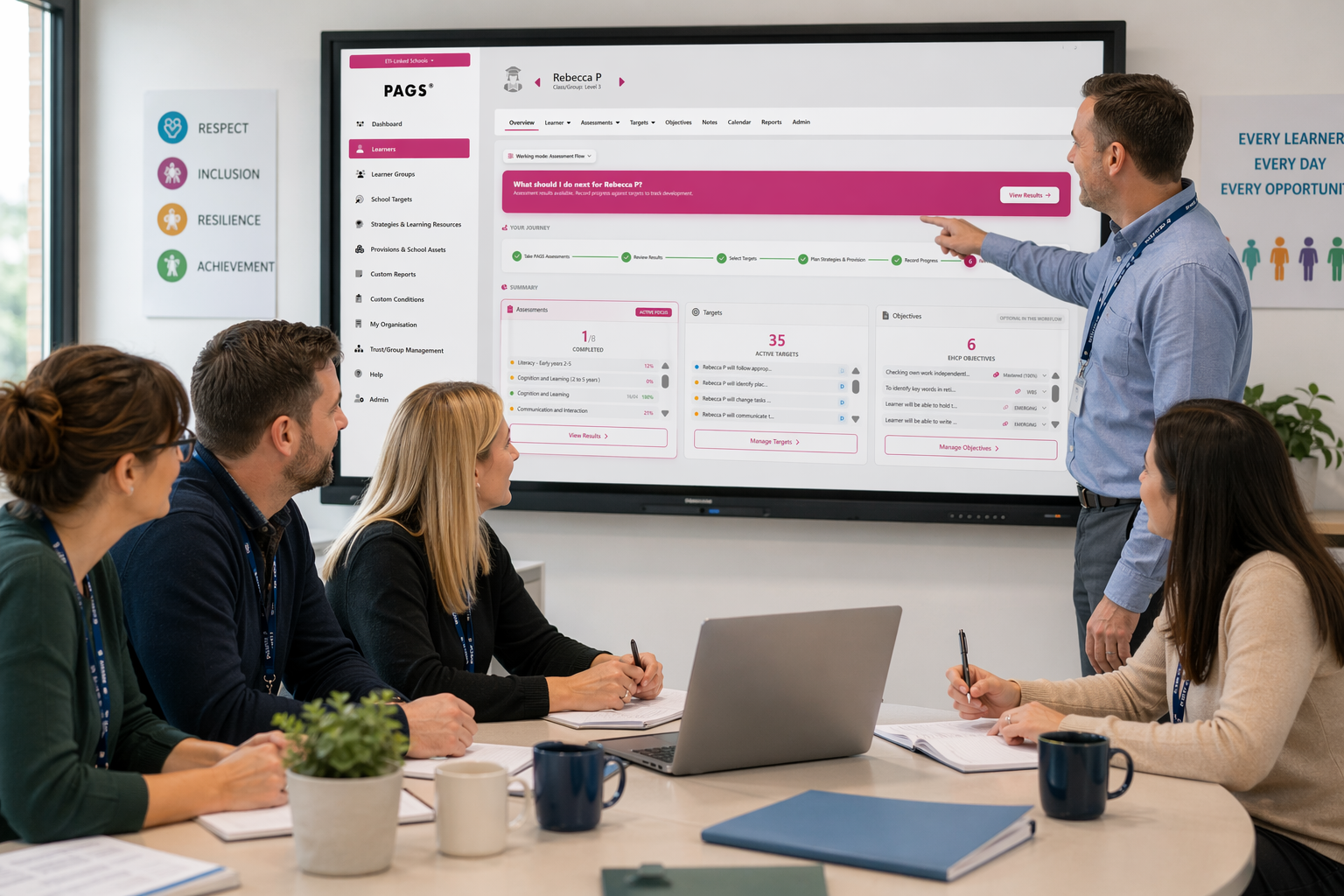
Most schools now run this through a dedicated platform rather than a shared spreadsheet. In PAGS, for example, assessment results surface a shortlist of targets matched to each learner's need, which the SENCO picks from and adapts, following the graduated approach without starting from a blank page. Teachers can then pull a lesson into the platform and have the most relevant target for that lesson surfaced automatically, with suggested tasks built around it, so the target and the lesson stay connected instead of living in separate places. Whatever system you inherit or choose, the test is the same: can a teacher, a parent or a governor understand a child's plan without you in the room to explain it?
5. Learn the EHCP process end to end: before you need it under pressure
Education, Health and Care Plans are the part of the role with the least room for error: statutory deadlines, multi-agency evidence, and families who are often anxious and exhausted by the time a request lands on your desk. Learn the process before your first live application, not during it.
The outline every new SENCO should know cold:
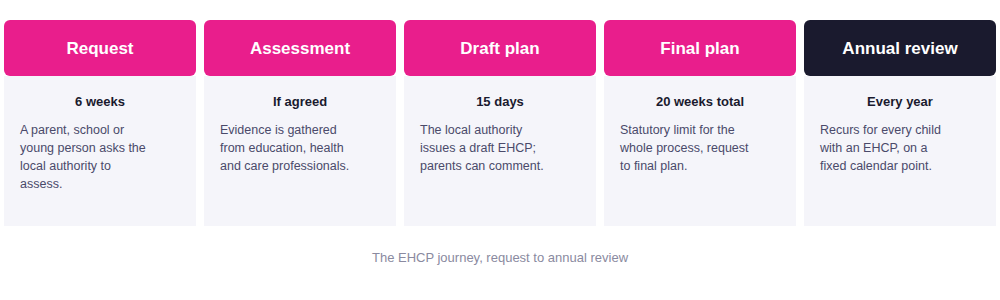
- Request: a parent, school or young person asks the local authority to assess. The authority has 6 weeks to decide whether to proceed.
- Assessment: if agreed, evidence is gathered from education, health and care professionals.
- Draft plan: the local authority issues a draft EHCP; parents have 15 days to comment.
- Final plan: the whole process, request to final plan, has a statutory 20-week limit.
- Annual review: every EHCP is reviewed at least once a year, and this becomes a recurring fixture in your calendar for every child who has one.
The single biggest driver of a weak or delayed application is evidence collected too late, scattered across different staff and formats. The schools that get funding decisions right tend to be the ones where assessment, targets and provision data were already being captured consistently, so the EHCP evidence pack is closer to “pull it together” than “start from nothing.” Building that habit from your first term saves the panic later.
There is a related problem once a plan is in place: EHCP outcomes are written broadly and cover a year or more, which makes day-to-day progress hard to see or evidence. Breaking each long-term outcome into smaller, trackable steps is what makes ongoing progress visible rather than something reconstructed under pressure at the annual review. PAGS is built around this: it helps break a broad, multi-year EHCP objective down into granular short-term targets, so tracking progress and pulling together the review report is far less of a scramble.
6. Build your relationships deliberately
SENCO is a leadership role without much formal authority: you rarely manage the teachers whose classroom practice you need to shape. The job runs on influence, so treat relationships as work, not a byproduct of it.
- Teachers: they deliver most provision day to day. Make plans easy to find and easy to act on; a target a teacher has to hunt for is a target that gets ignored.
- Parents: many arrive already frustrated by a system that has moved slowly. Clear, honest, regular communication does more to build trust than any single meeting.
- Governors: someone on the governing board should have SEND oversight. Get on their agenda early and bring them evidence, not just updates.
- External agencies: educational psychologists, speech and language therapists, social care; know who your local contacts are before you need to refer urgently.
- The SLT and headteacher: SEND budget, staffing and whole-school priorities are decided above your desk. Make sure your evidence reaches those conversations.
7. Get organised for the year, not just the week
The SENCO calendar has a rhythm once you know it: annual reviews spread across the year, termly provision reviews, an autumn-term cohort audit, governor reporting points, and an EHCP pipeline that never fully stops. Map that rhythm out as early as possible rather than discovering each deadline as it arrives.
A simple starting structure:
- Termly: review provision maps and targets against progress data; report to governors.
- Ongoing: annual reviews for every EHCP, scheduled as soon as the previous one closes, not left until the anniversary date creeps up.
- Autumn term: audit the register, agree whole-school SEND priorities with SLT, check training needs across staff.
- Whenever it happens: transitions (new starters, Year 6 to 7 moves, post-16 planning) tend to need more lead time than people expect.
A year planned out in week one is far less stressful than a year discovered one deadline at a time.
8. Know what's coming, without panicking about it
In February 2026 the government published the Every Child Achieving and Thriving white paper, setting out a new duty for schools to hold an Individual Support Plan (ISP) for every child with SEND, alongside a four-tier support structure and new funding for specialist places and staff training. None of it lands overnight: implementation runs from September 2030, existing EHCPs are unaffected until then, and there is nothing to rebuild in your first term. It is worth knowing the direction of travel early, though, because the schools that find this straightforward later will be the ones who were already keeping consistent, evidenced records rather than reconstructing them under pressure. Read the GOV.UK summary for parents and schools.
Where to get support
You are not meant to work this out alone. Worth building into your first term:
- NPQ SENCO training: covers the statutory content and connects you with a peer cohort of other new SENCOs.
- Your local authority's SEND team: most run SENCO networks, forums or drop-in support.
- A mentor: an experienced SENCO, in or outside your school, who can sense-check decisions before you have to defend them.
- National SENCO communities and training providers: useful for checklists, templates and case studies from people who have solved the same problems.
- A short CPD course: if you want something practical to point new teachers or teaching assistants towards, PAGS runs a 3-hour, CPD-accredited course, Embracing Neurodiversity: Supporting SEN in the Classroom, covering common SEND conditions and inclusive teaching approaches.
And once your register, assessments and provision data are consistent and up to date, the EHCP evidence and Ofsted reporting that used to take days of collating tend to take far less, whether through better spreadsheets or a platform like PAGS built specifically for SEND evidence and reporting. See how PAGS supports new and experienced SENCOs →
Sources
- How to Become a SENCO in 2026/2027, Real Training
- National Professional Qualification for SENCOs, Ambition Institute
- Your Ultimate SENCO Year Checklist, Sensible SENCO
- National Award for SEN Coordination (NASENCO), Real Training
- SENCO national professional qualification, GOV.UK
- SEND Code of Practice: 0 to 25 years, GOV.UK
- Schools white paper: what parents need to know about changes to the SEND system, GOV.UK Education Hub