Every learner, seen as a whole.
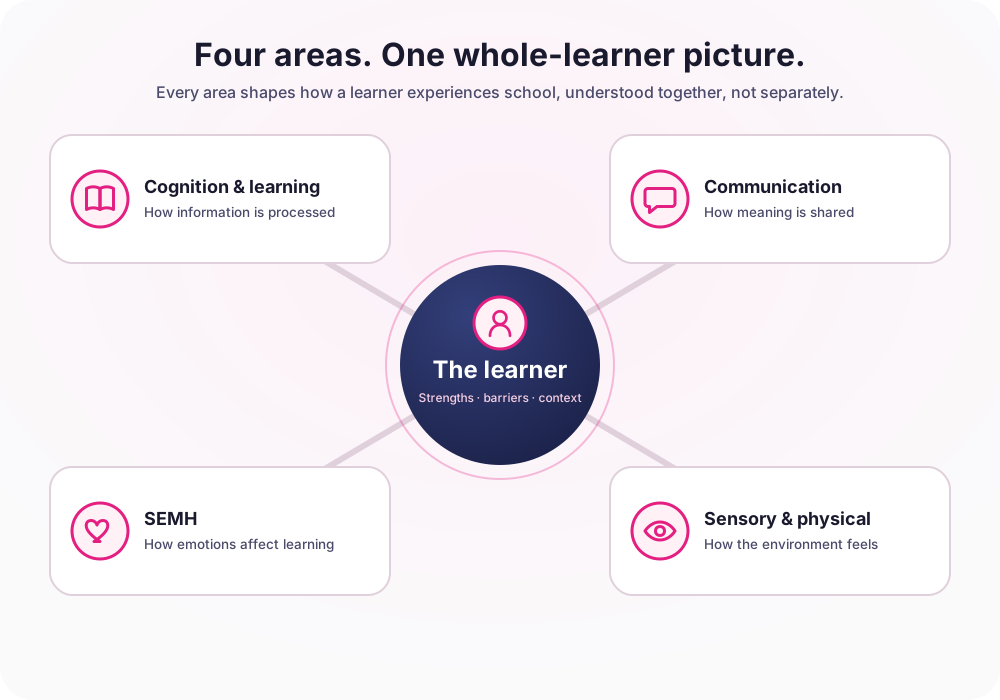
Four areas connect around one profile, so nothing is decided in isolation.
Every learner is unique. Diagnoses and labels can help, but they rarely tell the full story of how an individual learns, communicates, regulates their emotions, or interacts with the world. PAGS assessments build the developmental picture that turns identified need into meaningful action.
Four areas connect around one profile, so nothing is decided in isolation.
Assessment is the first step in a connected workflow. Every result feeds the next stage. The full chain lives inside one platform, not five.
Traditional assessments compare learners against age-related expectations. For many learners with SEND, that approach is limiting. It often fails to identify the underlying developmental gaps that prevent progress.
PAGS takes a different approach. Rather than focusing purely on chronological age, the assessment framework identifies the concepts, skills, and behaviours a learner has mastered, and highlights the next logical steps in their development. This aligns closely with the Rochford Review principles and supports the personalised, small-step approach widely recognised as best practice within SEND provision.
By understanding where development has been interrupted, delayed, or missed, schools can focus support on the skills most likely to unlock future progress.
Most assessment tools focus on a single area of need. PAGS assesses four interconnected developmental domains because they influence almost every aspect of learning, behaviour, independence, and social development.
Far more than speaking. The assessment explores vocabulary, receptive and expressive language, conversational and questioning skills, non-verbal and social communication, contextual understanding, and listening and attention. Surfaces barriers that affect learning, social interaction, and classroom participation.
Many learners can memorise information yet struggle to apply it. The assessment covers problem solving, decision making, planning and organisation, information processing, memory strategies, adaptability, generalisation of learning, functional understanding, money management, and independent thinking.
Successful learning depends on successful relationships. The assessment examines relationship building, social understanding, empathy, assertiveness, personal safety, social responsibility, rights and responsibilities, beliefs and values, community awareness, and understanding social situations.
Regulation has a significant impact on outcomes. The assessment covers emotional and behaviour regulation, adaptability, coping with change, managing anxiety and stress, physical and mental wellbeing, self-awareness, and concrete regulation strategies.
Each assessment area is organised into three developmental stages. The stages broadly reflect typical progression, but PAGS does not assume them by age. A learner is identified at the stage they are at, regardless of chronological age.
Foundation concepts and early developmental skills. The bedrock from which later learning grows.
Skills involving greater understanding, independence, and application. Concepts moving from learned to used.
More complex reasoning, self-awareness, and higher-level developmental skills. Application in nuanced contexts.
Following assessment, PAGS provides far more than a score. Schools receive a developmental profile, priority areas for support, identified strengths, areas of need, developmental stage indicators, progress tracking, and recommended next steps. The platform highlights the developmental gaps and surfaces the skills most likely to have the greatest impact on future progress.
One of the most powerful features of PAGS is the ability to move directly from assessment to intervention. The platform automatically generates a prioritised list of developmental targets based on the learner’s identified needs. Educators receive clear next steps, a practical intervention focus, structured support planning, and evidence-based recommendations. Rather than spending hours analysing results and deciding what to do next, schools can start planning support immediately.
Assessments do not exist in isolation. The results flow directly into developmental targets, objectives, learner plans, provision mapping, progress tracking, EHCP support, annual reviews, and reporting. Every other feature in PAGS draws on the same underlying assessment data.
The result is that assessment information becomes meaningful action rather than another report stored away and forgotten. Schools that have used PAGS for a year are not gathering evidence at EHCP time; the evidence has been gathering itself, day by day, since the first assessment was completed.
Assessment is not a one-off event. PAGS allows schools to reassess learners and compare results over time. This is how schools measure real progress, evaluate the effectiveness of interventions, identify emerging needs, demonstrate impact to inspectors and Local Authorities, support annual reviews, and strengthen EHCP applications.
The output is a clear visual representation of developmental growth across all four assessment areas. Not just a score that went up, but a developmental story of which gaps closed, which areas opened up, and where focus is needed next.
PAGS was initiated by Feliciea Jibson MEd, a qualified teacher with over 17 years of experience supporting learners with autism, severe learning difficulties, complex needs, and challenging behaviour. The assessment framework has been developed through collaboration with an international group of specialists, bringing expertise from education, psychology, speech and language therapy, assessment design, and SEND practice.
Contributors include speech and language therapists from the UK and Belgium, educational psychologists, autism specialists, inclusive education consultants, SEND practitioners, and specialist assessors. This collaborative authorship ensures that PAGS reflects both research and the practical realities of the classroom.
The assessments have been developed using evidence-informed practice and have been independently reviewed and validated through academic research, including by researchers at University College London. The platform delivers meaningful developmental insights while remaining practical and accessible for schools that need to use them under real-world time pressure.

Developmental targets are auto-generated from the assessment, with full flexibility to add academic and custom targets alongside. Objectives link smaller step targets to long-term outcomes.
Open Targets & Objectives →Learner Plans bring targets, interventions, staff hours, costs, and impact data together in one structured, evidence-rich record per learner. Aggregates into the school-wide Provision Mapping Dashboard.
Open Learner Plans →When the assessment data, targets, plans, and progress notes are all in one place, EHCP applications, annual reviews, and outcome reporting stop being a scramble. The evidence has built itself.
Open EHCP →Bring a real learner profile, a developmental concern, or just a question about how assessment connects to the rest of SEND provision. We will walk through how PAGS turns the assessment into action.
PAGS assessments span Communication and Interaction, Cognition and Learning, Social Interaction and Awareness, and Self-Regulation, across three developmental stages. Assessment authorship, independent UCL validation, automatic priority target generation, and progress comparison over time are live production features. Last reviewed: June 2026.