Built for education. Designed for trust. Every AI feature in PAGS is initiated by a user, reviewed by a user, and approved by a user before it touches a learner record. AI helps. Educators decide.

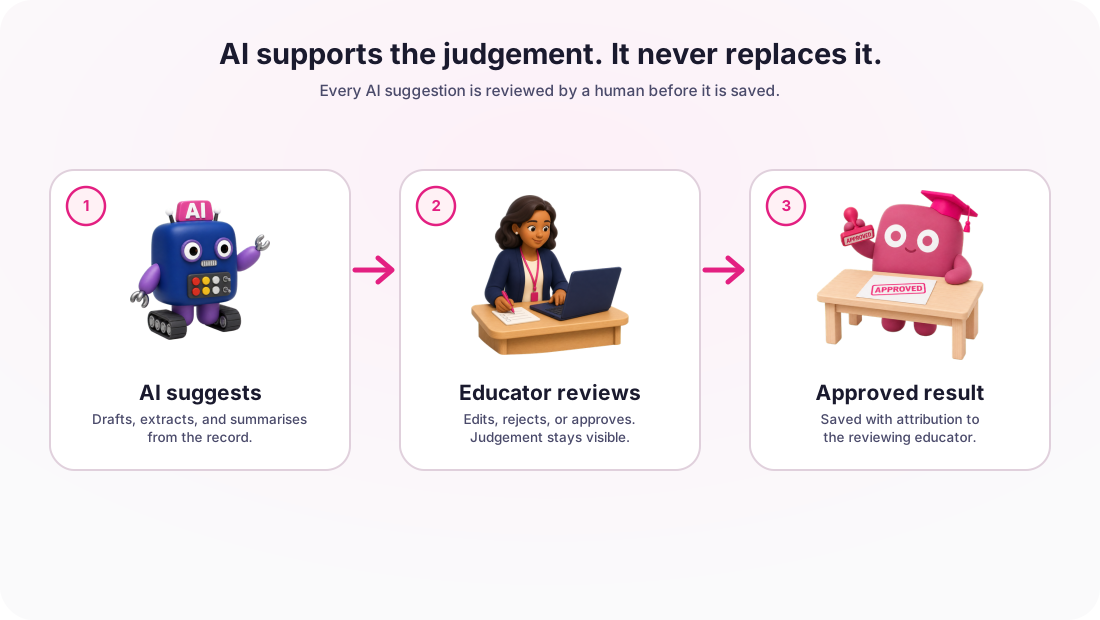
Every AI suggestion is reviewed by a human before it is saved.
Artificial intelligence has enormous potential to reduce workload, streamline administration, and help educators focus on what matters most: supporting learners. We have built AI into PAGS to solve specific, well-defined school problems. Not to chase headlines.
Whether it is reducing EHCP (UK) administration, helping teachers fit targets into lessons, analysing professional documents, generating objectives, or summarising progress, the goal is always the same. Save time. Reduce workload. Improve outcomes for learners.
If a feature does not pass all three tests, it does not ship.
Every AI action is initiated by a user, reviewed by a user, and approved by a user. Nothing is automatically applied to a learner record. The expertise of teachers, SENCOs, and support staff remains central to every decision.
Personally identifiable information is anonymised via Microsoft Presidio wherever possible before AI sees it. Processing happens in enterprise Azure OpenAI, in the EU region. School data is not used to train public AI models.
AI in PAGS exists to lift specific administrative burdens. EHCP (UK) analysis. Objective generation. Progress summaries. Lesson planning. Each feature is judged on whether it saves time and improves outcomes, not whether it sounds impressive.
AI should support professional judgement, never replace it. Unlike some AI-powered tools, PAGS AI does not make decisions on behalf of educators.
Every AI action must be initiated by a user. Every result is presented for review. Every result can be edited or amended. And every result must be approved before any information is added to a learner’s record. Nothing automatically writes itself into a child’s profile.
Transparency is part of the same principle. AI functionality in PAGS is clearly identifiable, and the user always knows when AI is being used, what information is being analysed, whether to accept the result, and what is ultimately saved. No hidden automation. No black-box decisions. Just tools that help educators work more efficiently with full visibility of what they are doing.
PAGS AI runs on Microsoft’s enterprise Azure OpenAI Service in the EU region. Not on public consumer AI tools. Processing happens within Microsoft’s managed cloud environment, with the security, privacy, and compliance controls schools, trusts, and public sector organisations expect.
As an additional safeguard, PAGS uses Microsoft Presidio to identify and anonymise personally identifiable information wherever appropriate, before any data is sent to AI services. Learner names. Staff names. Email addresses. Contact information. Other identifying details. The AI works with anonymised information wherever possible, minimising exposure while still delivering meaningful support.
We follow the principle of data minimisation. Only the information needed to complete a specific task is processed. Generating a progress summary uses relevant progress notes. Creating targets uses the information needed to generate them. Analysing an EHCP or similar support-plan document uses the contents of that document. Nothing more.
And school information processed through PAGS is not used to train public AI models. Your data remains under your school’s control at all times.
If you want the technical detail, the Security and Data Protection page sets out the Cyber Essentials Plus certification, the sub-processor list, and the exact 5-step AI pipeline.
Six concrete jobs the AI does well, every one designed around an actual school workflow.
Upload an EHCP or professional report. AI extracts objectives, targets, strengths, needs, parent voice, and learner voice. SENCO reviews and accepts each item before it saves.
Group selected targets into a broader objective, or take a broad EHCP outcome — or IEP/ISP goal — and break it down into the smaller step targets that build the pathway. Bottom-up and top-down.
Generate a term summary of progress notes against developmental targets, academic targets, objectives, or custom date ranges. Save a template, run it again next term.
Tell PAGS the lesson and AI picks which of the learner’s active targets fit best. It returns age-appropriate tasks, strategies, and evidence collection suggestions for that specific class.
Give the AI a lesson plan, an identified need, or a learning objective. It generates developmental, academic, or custom targets ready to review and assign in seconds.
Developmental targets are set from assessment results, which sometimes means a target reads younger than the learner’s chronological age. PAGS highlights those and rewrites them at a single click, personalised with the learner’s name.
Cyber Essentials Plus certified. Hosted in the EU. Microsoft Presidio anonymisation pipeline shown end to end. Sub-processor list, GDPR posture, and procurement bundle all on one page.
Open Security →Scenario-led walk through PAGS AI in real workflows. The new EHCP (UK) on a Tuesday afternoon. Term reports in an afternoon. Tomorrow’s lesson, matched to active targets. The EHCP (UK) application that writes itself from the evidence already in PAGS.
Open the AI feature page →If your DPO, your governors, or your parents ever ask how AI is being used with their children’s data, you should be able to answer simply and confidently. We built PAGS AI to make that answer easy.
This page describes the principles and architecture behind PAGS AI features. Specific feature behaviour evolves as the product develops; the principles, including human approval, Microsoft Presidio anonymisation, no public model training, and data minimisation, remain consistent. Last reviewed: June 2026.