PAGS rocket logoPAGS vs your MIS

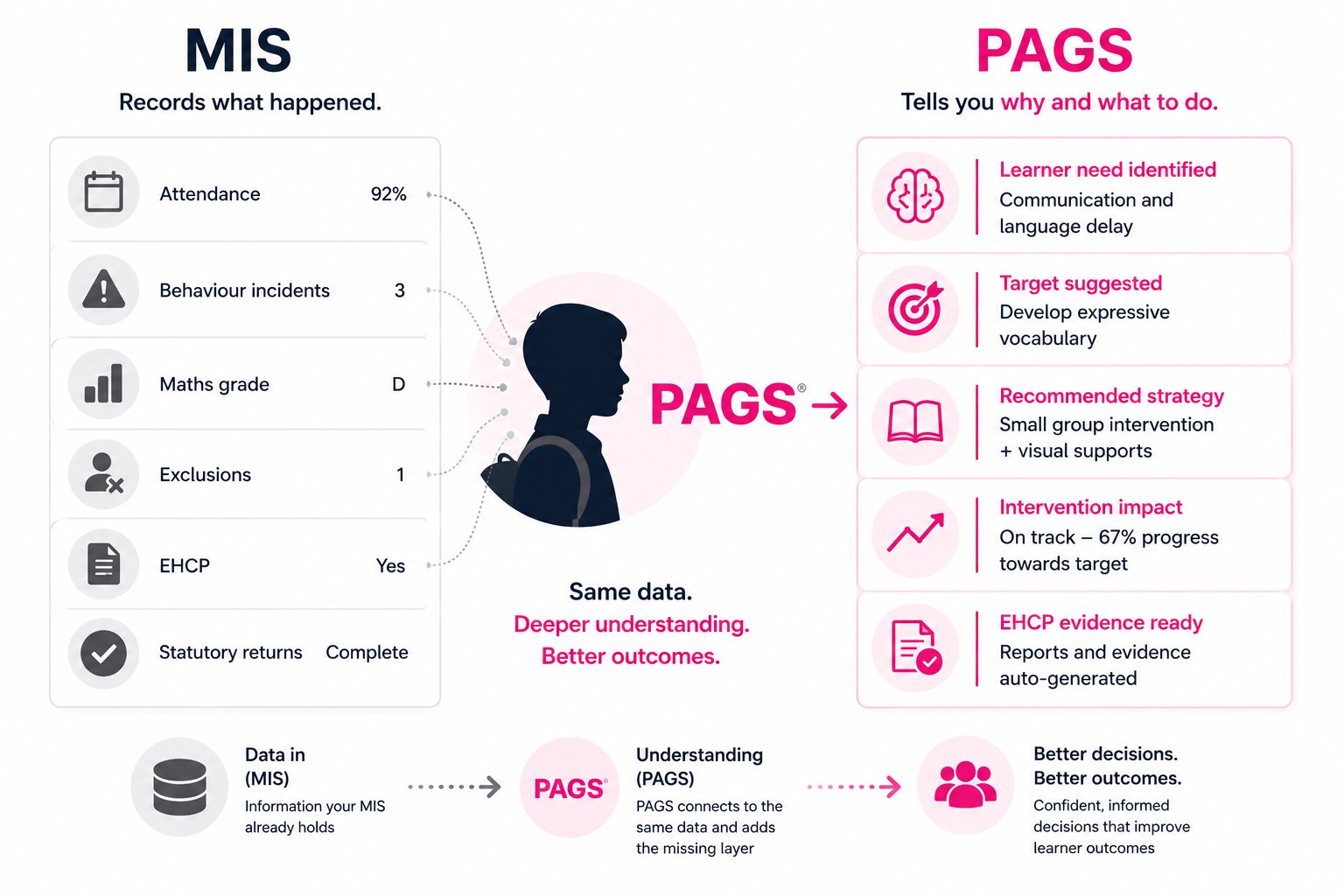
Your MIS records what happened.
PAGS tells you why and what to do.

Your MIS is built for compliance, attendance, behaviour, and statutory returns. It does that job well. It was never designed to answer questions about learner need, intervention impact, or EHCP evidence. PAGS sits on top connected to the same data  and adds the layer that your MIS can’t.

PAGS doesn’t replace your MIS. It works alongside it, adding the learner-need layer.
PAGS rocket logo

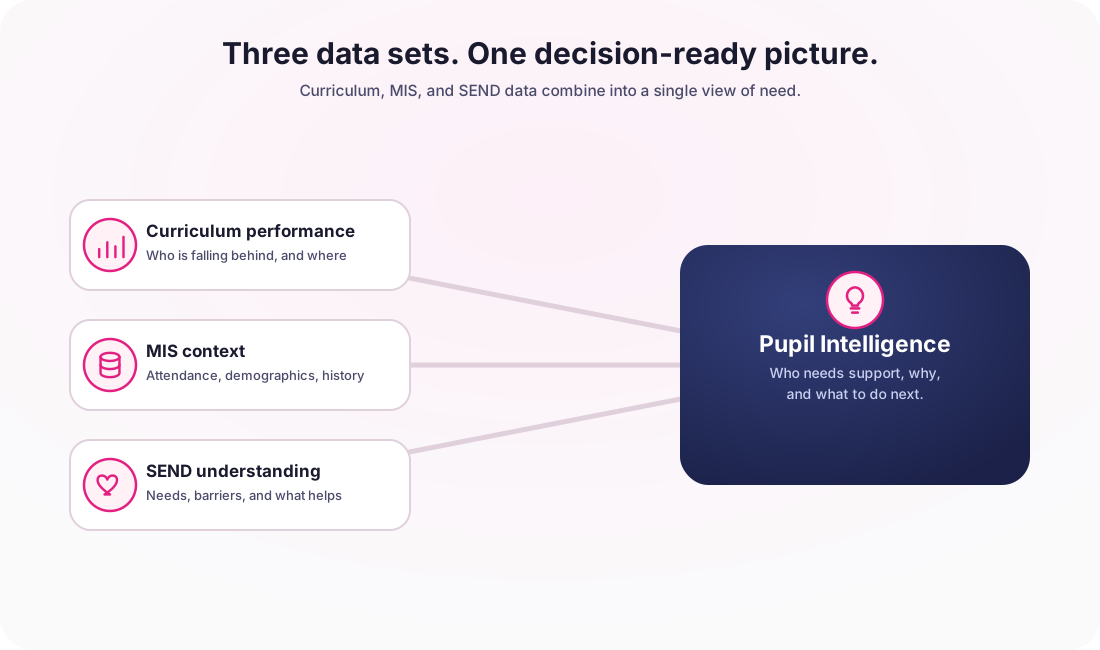
Three data sets. One decision-ready picture.

Curriculum, MIS, and SEND data combine into a single view of need.

Diagram showing curriculum performance, MIS context, and SEND understanding combining into one pupil intelligence picture.
WORKS WITH YOUR STACK

PAGS sits on top of the MIS you already have.

No rip and replace. PAGS connects with the systems schools and trusts already use, keeping curriculum data, attendance, and timetabling in your MIS, and adding the learner-need layer above.

PAGS platform screenshot

Five questions that need an answer. Your MIS can’t give you one.

Each of these is a daily leadership question. Each requires data your MIS doesn’t carry. Each is answered by PAGS, without leaving your existing systems behind.

01

Why is Year 2 Maths underperforming?

MIS: shows the cohort scored below average. No further breakdown by learner need available.

PAGS adds: SEN-filtered curriculum analysis in one click. See whether 68% of the underperformers have identified needs and where the gap is. Choose between a teaching response and a provision response, with evidence either way.

02

Which learners need intervention now?

MIS: shows attendance and grade decline at term end. Useful in retrospect, not in real time.

PAGS adds: live provision impact scores, per learner, per week. The SENCO and SLT see which interventions are working, and which aren’t, before half-term, not after the next data drop.

03

What does the new teacher need to know?

MIS: shows assessment results and attendance. No context on what each learner needs in the classroom.

PAGS adds: a full learner profile from day one. Pupil Passport, current targets, what works, what to avoid, ready before the first lesson. No handover meeting required.

04

Is current provision actually working?

MIS: shows attendance, exclusions, and end-of-year grades, not provision-level outcomes.

PAGS adds: cost per learner versus progress score, every term. Make the SEND budget case to governors with provision-level evidence, not anecdote.

05

EHCP evidence ready for inspection?

MIS: stores assessment outcomes and statutory data. Not the qualitative trail of intervention and impact an inspector wants.

PAGS adds: a complete, timestamped, attributed audit trail of every assessment, target, intervention, and parent contact, built by daily practice and ready before you knew you’d need it.

The full comparison

Two more things your MIS doesn't do.

The question
What your MIS shows
P
What PAGS adds
Can a parent see their child’s plan?
Limited parent portal: statutory updates only.
Dedicated Parent Portal with targets, progress, observations, two-way notes.
How is best practice transferred between teachers?
Not in scope.
Pupil Passport, @ mentions, attributed notes: best practice spreads in-system.
What PAGS adds on top of your MIS

Two different jobs. One connected picture.

PAGS is not a replacement for your MIS. It is a complement.
The learner-need layer your MIS was never designed to carry.

Your MIS

Records what happened.

  • Attendance, behaviour, exclusions
  • Statutory returns and census
  • Assessment results and grades
  • Pupil demographic and contact data
  • Financial and operational records

Compliance-grade. Necessary. Doesn’t answer leadership questions about learner need.

PAGS adds

Tells you why and what to do.

  • SEN-filtered curriculum intelligence
  • UCL-validated assessments across all four areas of need
  • Live provision impact scores per learner
  • EHCP application packs that build themselves
  • Pupil Passport, parent portal, audit trail

Built on top of your existing MIS. No data migration. Schools live in 1–2 days.

In practice

When the MIS-plus-PAGS combination works.

Instead of seeing three children a day because of all the different hurdles we used to go through, I can now see up to five students a day. Before, interventions were not being recorded. Now the whole school is doing them.

Michelle Bramhall · SEND Lead, Stone Soup Academy

Ofsted Outstanding (June 2025), third consecutive

Before you book: PAGS shows you which pupils are falling behind, why, and what to do next.

UCL validated · 4 countries · From £1,450/year · GDPR compliant