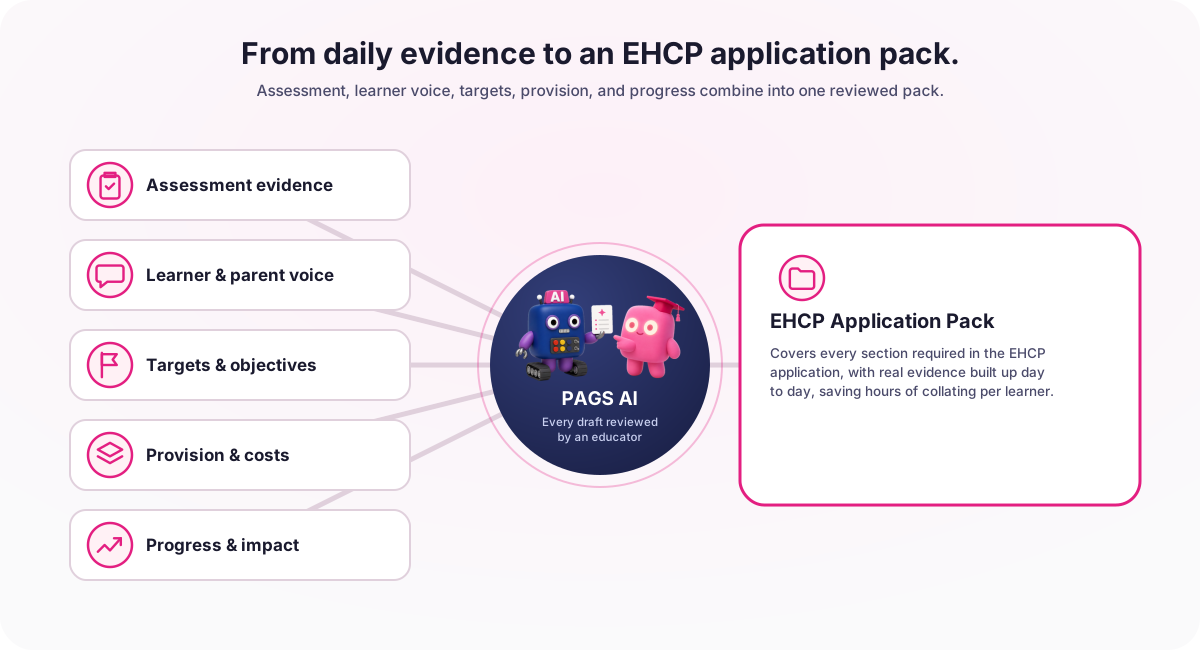
From daily evidence to an EHCP application pack.
Every objective, target, and progress note builds toward a submission-ready pack.
In February 2026, the Department for Education published Every Child Achieving and Thriving, the most significant reform to the SEND system in a generation. It introduces statutory duties, new accountability frameworks, and a clear vision for what inclusive schools must do.
Schools now need to act. And the platform most of them are looking for already exists.
Every objective, target, and progress note builds toward a submission-ready pack.
Every Child Achieving and Thriving sets out seven areas of change that directly affect how schools identify, plan for, and report on learners with SEND. Below is what the government says, what it means in practice, and how PAGS responds to each one.
“We will require all schools and other educational settings to create digital Individual Support Plans for any child or young person with identified SEND.”
“The plans will capture barriers to learning, day-to-day provision, any reasonable adjustments and intended outcomes. They will be developed with input from and to communicate with parents, strengthening collaboration between home and school.”
“We will set a requirement for Individual Support Plans to be reviewed annually at a minimum, which will involve discussions with parents. The use and quality of Individual Support Plans will be assessed through Ofsted’s inspections and assessment of SEND provision at a setting level.”
Every Child Achieving and Thriving, DfE, February 2026
Every child receiving Targeted or Specialist SEND support will need a digital plan capturing their needs, their provision, and their intended outcomes. It must be created with parents, reviewed at least annually, and will be scrutinised by Ofsted.
Schools that are still running SEND plans on Word documents, spreadsheets, or paper files are not compliant with this direction of travel. The duty is clear, the timeline is moving, and inspection will follow.
The government is describing something PAGS has built and refined for years: the PAGS Learner Plan.
A Learner Plan starts with a title and a description: what you are trying to achieve for this child and over what period. You then add items to the plan: targets, objectives, and provisions. Each item connects the goal to the action. Every item carries the full picture of what that support looks like in practice: the member of staff delivering it, the hours committed, the frequency and number of sessions, and the cost.
The plan then does the work. It calculates total hours, total impact score, and total cost across all items. You set a budget at the plan level, and PAGS shows you exactly how much remains. At a glance, any SENCO, headteacher, or governor can see what this child’s support package consists of, what it costs, whether it is having impact, and how it maps to their specific needs and intended outcomes.
This is not a reporting template. It is a live, structured, digital plan, exactly what the government’s ISP duty describes. The white paper says plans must capture “barriers to learning, day-to-day provision, any reasonable adjustments and intended outcomes”. The PAGS Learner Plan captures all of these, linked together, with costs and staff attached, and updated each term as progress is recorded.
For years the sector pushed back on per-learner plans, preferring group-based provision maps. PAGS has always offered per-learner planning because the evidence supports it. The white paper has now confirmed that individual, learner-level plans are the statutory requirement. PAGS didn’t need to rebuild. It was already there.
When Ofsted arrives, the evidence base is complete. Every item is time-stamped. Every update is recorded. The plan shows what was intended, what was delivered, and what difference it made.
Students receive progress reports every term, with staff reviewing progress alongside learners, turning plans into active conversations rather than static documents.
Michelle Bramhall · SEND Lead, Stone Soup Academy
Three consecutive Ofsted Outstanding judgements, June 2025
“We will work closely with schools, trusts, local authorities, communities, families and family-facing organisations to establish minimum expectations that support the creation of meaningful home-to-school partnerships.”
“Effective and timely school communication, including the data and information that schools routinely share, making use of available technology to share up-to-date information where possible.”
“Empowering families to support learning at home by signposting practical guidance, support, and resources.”
“The voices of children should be at the heart of decision making.”
Every Child Achieving and Thriving, DfE, February 2026
The Secretary of State has been explicit: she wants parents backing schools and taking an active role in supporting their children’s learning at home. The white paper introduces minimum expectations for home-school partnership, including requirements to share timely information, empower parents to support learning at home, and involve parents in ISP creation and annual review.
This is not a soft aspiration. ISPs must be “developed with input from and to communicate with parents.” Parent voice must shape plans. And technology is specifically cited as the tool to make this happen.
PAGS has a dedicated parent portal, built specifically to turn the aspiration of home-school partnership into a daily reality.
Parents can log in and add a Parent Voice directly to their child’s record. Their observations, concerns, and insights become part of the evidence base, not a separate conversation that gets lost. They can see which targets are currently live for their child, read progress notes added by staff, and comment on them. Staff can @mention parents to draw their attention to something specific. Parents can @mention staff to flag something from home.
This is where PAGS goes further than any communication app or newsletter: the parent isn’t just informed, they’re invited to participate. Every child’s plan includes a guidance area where staff can highlight which targets the parent should actively work on at home. Staff can add suggested tasks, resources, and guidance, and parents can tick off each one, add progress notes, and upload images or videos showing what’s happened outside school.
This is the 360-degree education approach the white paper calls for. Learning doesn’t stop when the bell rings. Parents who can see live targets, contribute to plans, and record their own observations aren’t passive recipients of school communication. They are partners in every sense. The white paper calls it a minimum expectation. PAGS makes it a daily practice.
“Parents are searching for support, but too often services have been stripped away.”Every Child Achieving and Thriving, DfE, February 2026
The PAGS parent portal changes this. When parents can log in, see what their child is working on today, and add their own voice to that record, the relationship between home and school is transformed.
“Schools will be required to publish an Inclusion Strategy outlining how resources are deployed to benefit children with SEND, which will be subject to oversight and challenge.”
“Schools and other education settings will be held accountable for how they use all their inclusion funding, including both the new Inclusive Mainstream Fund resource and the funding they already receive to provide support for children with SEND through their notional SEN budgets.”
Every Child Achieving and Thriving, DfE, February 2026
The government is investing £1.6 billion in a new Inclusive Mainstream Fund and asking schools to account for how every pound of SEND funding is used. An Inclusion Strategy must be published. Ofsted, governors, and RISE will all scrutinise how resources are deployed and whether they are having impact.
Schools that cannot answer the question “which provision is each student receiving, what does it cost, and what difference is it making?” will struggle under this framework.
PAGS provision mapping gives you a live, school-wide picture of exactly which provisions are in use for each learner: the type of intervention, who delivers it, how often, and the cost. Every provision is linked to the learner who receives it and the outcomes it is intended to support.
Impact scores track whether each provision is making a measurable difference, drawing on assessment results and progress notes to give leaders a data-driven view of what is working and what needs to change. This isn’t retrospective reporting. It is ongoing, actionable insight.
When it comes to producing your Inclusion Strategy or presenting to governors and inspectors, the data is already there. You can show exactly where SEND funding is going, what each intervention costs, and what the evidence says about its impact. No spreadsheet archaeology. No manual compilation. The platform you use every day generates the evidence your accountability framework requires.
“With one in three children being identified with SEN at some point in their schooling, we must equip our schools to identify when children need additional support to achieve and thrive.”
“Children and families should receive the support they need as soon as possible, with a quick response to changing needs, focusing on providing support earlier in children’s lives when this can have the greatest impact.”
“The school follows a graduated approach to supporting SEND, following a cycle of assess, plan, do and review, to monitor pupil progress and remove any barriers to learning.”
Every Child Achieving and Thriving, DfE, February 2026
The white paper places early identification at the centre of the reformed SEND system. Universal, Targeted, and Specialist tiers must operate with clarity and evidence. The Code of Practice will be updated with refreshed areas of development, and the assess-plan-do-review cycle is embedded as the expected approach at every layer.
PAGS is built around validated assessments covering all six areas of development, including Communication and Interaction, Cognition and Learning, Social, Emotional and Mental Health, and Sensory and Physical needs. Assessments identify precisely where a learner is and what they need. Not a broad category or a diagnosis, but specific, measurable, actionable evidence.
The assessment results feed directly into target-setting, provision planning, and ISP creation. The cycle of assess-plan-do-review is not a framework bolted on. It is the architecture of the platform. Each term, staff record progress against targets. Assessments can be re-run. The plan updates. The evidence accumulates.
When needs escalate, the documentation supports an EHCP application. PAGS generates the pre-populated EHCP Application Pack from the records already in the system: Learner Voice feeding Section A, assessment results feeding Section B, provision records feeding Section F. The SENCO is reviewing and refining, not starting from scratch.
“SENCOs are essential to the school workforce in supporting children and young people with SEND, but to spend too long on administrative tasks would be the wrong approach for SENCOs to focus on, as it diverts them from strategic and leadership tasks.”
“Schools should empower SENCOs to focus on strategic, evidence-led inclusive practice rather than administrative coordination.”
Every Child Achieving and Thriving, DfE, February 2026
The white paper challenges schools to free SENCOs from the spreadsheet-and-paperwork burden that has consumed the role for years. The expectation is that SENCOs lead inclusive practice, coach colleagues, analyse impact, and shape strategy. The Code of Practice will reinforce this direction. Schools that keep their SENCO buried in compliance admin will not be meeting the standard.
PAGS gives the SENCO the time back. Plans are templated. Assessments auto-score and visualise progress. Parent communication is structured through the portal. EHCP packs are pre-populated from existing records. Ofsted evidence is generated automatically from the work already happening in the platform.
The administrative tasks the white paper warns against are the very tasks PAGS removes. What is left is the strategic work: reading the data, coaching staff, refining the inclusion strategy, and engaging parents and learners in genuine partnership. PAGS is the operational backbone that lets the SENCO step into the leadership role the government is now requiring.
“Bourne SENCOs gained back the equivalent of 14 staff working days in just one month, allowing them to focus on what really matters: working with children and supporting colleagues.”Bourne Education Trust case study
“Inclusive practice is the responsibility of every adult working in the school, not just the SENCO.”
“We will work with the sector to develop tools and resources that schools can use to support the high-quality delivery of inclusive practice.”
Every Child Achieving and Thriving, DfE, February 2026
The reformed system distributes responsibility for inclusion across the whole staff. Class teachers, teaching assistants, pastoral leads, and middle leaders all need visibility of learner needs, plans, and provision. Schools need a shared operational picture, not siloed knowledge held by one person.
PAGS is a whole-school platform. Every teacher can see the plans, targets, and notes for the children in their class. Every TA can record what they delivered in a session, against the specific provision and target. Every middle leader can see how learners in their year group are progressing. Every member of staff is part of the inclusion picture, contributing to the evidence base, sharing observations, and reading the latest plan before the next lesson.
This is the shared operational layer the white paper assumes will exist. Most schools don’t have it yet. With PAGS, you do.
“Ofsted’s renewed inspection framework will provide more focus on a setting’s effectiveness in identifying and meeting the needs of children with SEND.”
“The Regional Improvement for Standards and Excellence (RISE) teams will work alongside schools, helping them to improve outcomes for children with SEND.”
Every Child Achieving and Thriving, DfE, February 2026
Inspection will examine the quality of ISPs, the effectiveness of provision, the impact of spending, and the strength of parent engagement. RISE teams will support and scrutinise. Governors will ask harder questions. The bar has been raised on all fronts at once.
Every Ofsted-facing question is already answered by the platform. Are ISPs in place for every SEND learner? Yes, show the dashboard. Are they reviewed at least annually? Yes, every change is timestamped. Is parent voice captured? Yes, here are the entries. Is provision having impact? Yes, here are the impact scores and assessment trajectories. Is funding deployed effectively? Yes, here is the cost-per-learner and intervention-by-intervention breakdown.
The evidence is not assembled the night before. It accumulates day by day, as part of how the school operates. When inspection arrives, the story tells itself.
Three trusts, three contexts, one shared platform doing the work the white paper now requires.
Learner Voice and Parent Voice built into every plan. Every learner has an ISP. Every plan has targets, impact, and review notes. Live evidence base, not a folder of static PDFs.
Read the story →A single inclusion platform across multiple schools. Consistent ISPs, shared assessments, trust-wide reporting on provision and outcomes. Exactly the operational backbone RISE will be looking for.
Read the story →SENCOs gained back 14 staff working days in a single month after adopting PAGS. The administrative load the white paper warns against, lifted. Time freed for the strategic, evidence-led work the reformed system requires.
Case study coming soonThe white paper sets a clear direction. The duties are coming. The inspection focus has already shifted. PAGS is the platform that already does what schools are now being asked to do, in one place, for every learner, with parents involved, with the evidence built in.
References on this page are drawn from Every Child Achieving and Thriving, the SEND and AP white paper published by the Department for Education in February 2026. The full document is available on gov.uk. PAGS is an independent platform and is not endorsed by the Department for Education.